
Call for your free consultation:
(555) 555-5555Indianapolis Drug Crime Defense AttorneyIn the attempt to continue waging an active drug war, the government has several legal remedies available to help prosecute any individuals that are believed to be involved in illegal drug activities. One of the most often used tools of the government is the “Maintaining a Common Nuisance” charge. If you have been charged with maintaining a common nuisance in relation to a drug crime, you need the assistance of an Indiana drug crimes attorney. Call our office at (317) 721-9858 or email our office at info@jksanchezlaw.com.
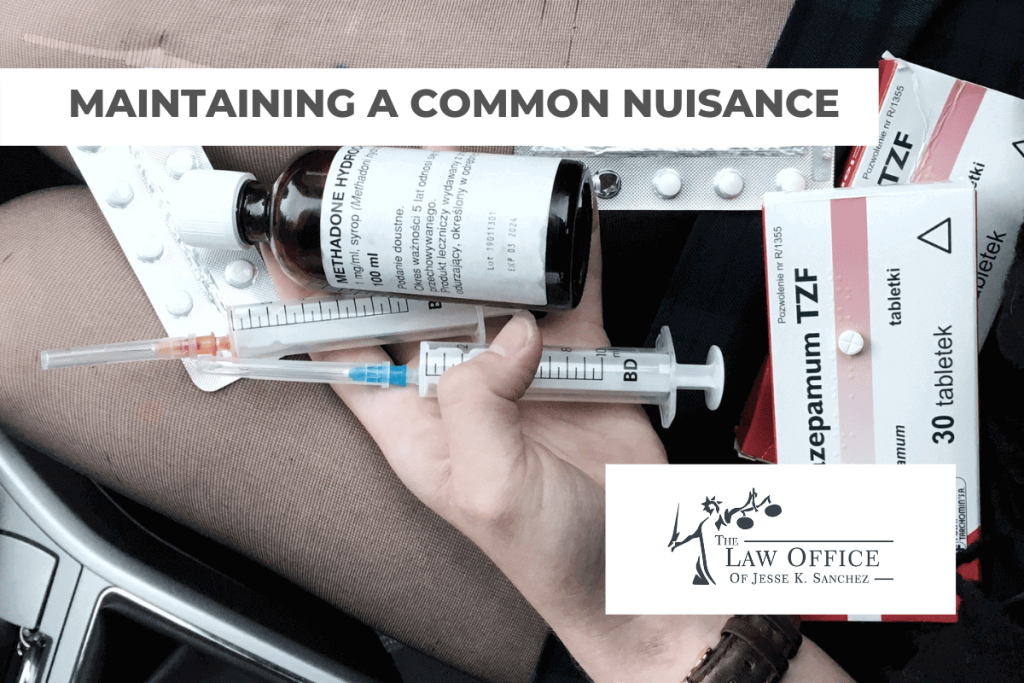
According to Indiana law, a place of common nuisance is any private property where any type of illegal activity is taking place. Private property areas include the following:
The most frequent crimes that occur in a place of common nuisance include the consumption and selling of illegal controlled substances and/or drug paraphernalia. Illegal substances include any of the drugs that fall on the schedule of the DEA controlled substance. Controlled substances are not required to be sold at the location. Controlled substances can just be stored in the space, and the property holder can be charged with a Class D or Level 6 Felony.
Sec. 13. (a) A person who knowingly or intentionally visits a building, structure, vehicle, or other place that is used by any person to unlawfully use a controlled substance commits to visiting a common nuisance, a Class B misdemeanor.
(b) A person who knowingly or intentionally maintains a building, structure, vehicle, or other places that are used one (1) or more times:
(1) by persons to unlawfully use controlled substances; or
(2) for unlawfully:
(A) manufacturing;
(B) keeping;
(C) offering for sale;
(D) selling;
(E) delivering; or
(F) financing the delivery of; controlled substances, or items of drug paraphernalia as described in IC 35-48-4-8.5; commits maintaining a common nuisance, a Class D felony.
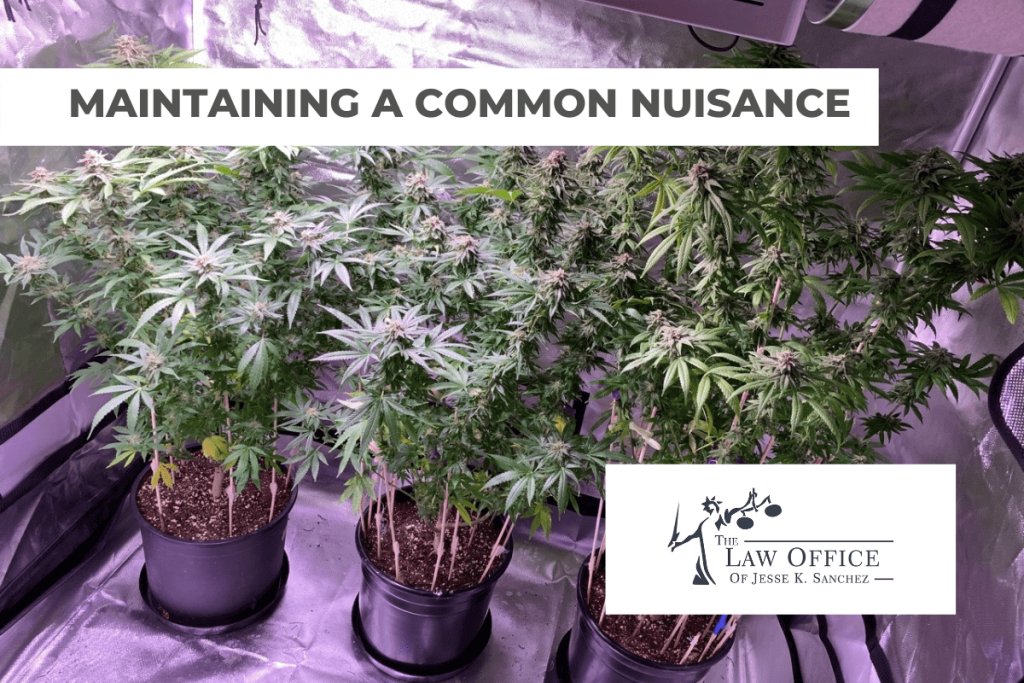
There are certain defenses to maintaining a common nuisance charge in Indiana. Though not all-inclusive, one of the primary defenses to maintaining a common nuisance charge would be if:
(1) the location was not primarily used for specified unlawful acts;
(2) the charged offense involves less than a specified quantity of marijuana, hashish, hash oil, or salvia or involves paraphernalia; and
(3) the person does not have a prior unrelated conviction for maintaining a common nuisance.
There are other defenses that could be used to fight this particular crime related to drug charges, which is why we suggest reaching out to Indiana drug crime defense attorney, Jesse K. Sanchez for assistance in fighting this particular charge.
Fighting against charges related to drug crimes in addition to providing criminal defense for a number of other charges is what we do the best. Our phone number is (317) 721-9858, email us at info@jksanchezlaw.com, perform a quick search for “drug crime attorney near me” or even search “drug dealing attorney near me”, and our office will show up right there. We look forward to helping alleviate what could be an extremely stressful time, receiving a charge for maintaining a common nuisance in Indiana.
It’s not every person that faces a felony charge proceeds to a plea or trial. The prosecutors dismiss many charges. Therefore, the first step or task to get a felony charge dismissed is by the defense attorney determining grounds to dismiss the felony charge. If you have been charged with a felony in Indiana, then an Indianapolis criminal defense attorney can show you how to get out of a felony charge. Just give us a call at (317) 721-9858 or email info@jksanchezlaw.com. Now, below are grounds for felony dismissal.
For police to arrest a person, it is a must for them to have probable cause to believe that they committed a crime. Therefore, a police officer cannot stop a person because they feel that he robbed a liquor store. He should have probable cause to believe that the said person robbed the liquor store from the objective factual facts in his possession. These facts may come from witnesses or CCTV/
TV footage describing the robber. Therefore, if the police officer arrested a person without any description from eyewitnesses or CCTV footage, he charged him without any probable cause, which may be dismissed by the prosecutor.

A police officer can only stop a person or a vehicle only under certain circumstances. These circumstances include violating traffic laws, over speeding, or if police officers believe that the suspect is committing a crime. Therefore, it is illegal and breaks one’s constitutional rights if a police officer randomly stops a person based on his race or religion. Police can only search your house or car if they have a search warrant and in other particular circumstances without it. Therefore, if police officers search your home or car without a search warrant and that no exceptional event permitted this search, then no evidence gathered during the investigation can be used against you in the court of law.
Suppose the key witness in a felony charge is unavailable to testify, or the prosecutor loses essential physical evidence. In that case, the prosecutor has no choice rather than dismiss the felony charge. This is because there is no evidence to prove that a crime was committed beyond a reasonable doubt. There are cases where physical evidence is so crucial that a prosecutor can’t prove the case without it. Moreover, if a person dies, disappears, or refuses to testify based on Fifth Amendment grounds, the prosecutors lack enough evidence and have no other choice but to dismiss the charges.
It is essential that when you are facing felony charges to consult a criminal attorney. This is because a criminal defense lawyer or attorney can evaluate the case and evaluate whether there are sufficient grounds to file a motion to dismiss the felony charges. Although other grounds may lead to felony charges dismisses, the defense attorney has to find the loopholes in the charges and have them dismissed. Call the Law Office of Jesse K. Sanchez at (317) 721-9858.
If you’re still dealing with the many consequences of a past DUI, you may be wondering, how do I get a DUI removed from my record? Driving under the influence is a serious crime. A drunk driver or a drunk bicyclist endangers other peoples’ lives as well as his own. Drinking alcohol impairs a driver’s vision, judgment and renders the driver utterly incapable of safely operating a motor vehicle. If you have been charged with an OWI in Indiana, reach out to a top rated DUI defense lawyer at (317) 721-9858 for assistance right now.
Having a DUI on your driving record may result in the inability to secure future employment, housing, financing, losing a license, and other benefits. Therefore, it is crucial to seek ways of expunging DUI from driving records to protect your future and your image to the public. Driving records function under specific terms. Less serious driving wrongdoings are detached from a driver’s record after a particular period. In some countries, removing the offense from the driver’s records requires a formal request by an attorney.
A DUI, whether a misdemeanor or felony, ultimately requires an intervention of expunging driving records on file held by the court, police stations, correctional programs, and other criminal justice authorities. The records related to either arrest, detainment, legal proceeding, or disposition must be wiped off from unrestricted view to safeguard the driver’s image.
One way to determine if a DUI is eligible for expungement is behavior during the probation period. An offender who has a positive attitude during the probation term gets an advantage of DUI removal from driving records. There are general requirements that one must satisfy to be eligible for expungement. One of the requirements is that there must be some form of probationary factor to the DUI conviction. If there was no probation, the offense was severe enough that the offender was sent to prison, and as such, the DUI may not be removed from the driving record.
Secondly, the offender must comply with the requirements of DUI probation without violating the terms. If the probation records indicate that you did not violate the terms, you can negotiate a DUI’s removal from your driving records. Lastly, the offender must not have a pending criminal case when they ask for the removal of DUI from driving records. An offender will be denied their request if the court understands that the removal of DUI is caused by fear from you or your attorney.
Having a DUI removed from driving records gives you freedom to enjoy your life after the conviction as well as clearing your name from the legal records. When it comes time to remove a DUI from your driving record, call an Indiana DUI expungement attorney at (317) 721-9858 or email info@jksanchezlaw.com for assistance with removing a DUI conviction from your criminal record today.
In the state of Indiana you can be charged with public intoxication if you have been consuming alcohol or a controlled substance in a public area or a place of public resort. Under Indiana law you can also be charged with public intoxication if you are in a vehicle used for public transportation (bus, trolley, cruise boats, taxi), at an airport, train station, or in a movie theater. If you are arrested with an alcohol intoxication charge, you need to contact an attorney for public intoxication charges, The Law Office of Jesse K. Sanchez at (317) 721-9858 or email info@jksanchezlaw.com.
The Indiana Public Intoxication Law, Indiana Code 7.1-5-1-3 states:
(a) Subject to section 6.5 [IC 7.1-5-1-6.5] of this chapter, it is a Class B misdemeanor for a person to be in a public place or a place of public resort in a state of intoxication caused by the person’s use of alcohol or a controlled substance (as defined in IC 35-48-1-9), if the person:
(1) endangers the person’s life;
(2) endangers the life of another person;
(3) breaches the peace or is in imminent danger of breaching the peace; or
(4) harasses, annoys, or alarms another person.
(b) A person may not initiate or maintain an action against a law enforcement officer based on the officer’s failure to enforce this section.
Essentially, public intoxication is being under the influence of alcohol or drugs in a public place. You can usually be ticketed on private property for public intoxication if charges are pressed by the land owner. A local alcohol intoxication attorney should be consulted if you are looking to fight your charges.
Is public intoxication a criminal offense? Even worse. What happens when you get arrested for public intoxication? According to Indiana law, the intoxication law in Indiana states that it is DEFINITELY a crime. If you are arrested for public intoxication in Indiana the law enforcement officer can do one of two things. One option is much more desirable than the other. With the first option, the officer will arrest you, and will take you to jail if you are endangering the well being of yourself or others around you. Another reason they would take you to jail is if you area public nuisance. The second option, which is far more desirable, is that the officer may take you to your house, a relatives house, a responsible friends house, or leave you in the custody of someone that is willing to give consent to take care of you. The section of the Indiana state code pertaining to public intoxication is usually for people publicly intoxicated because of alcohol, and not due to the use of controlled substances. Bailbuy testosterone enanthate half life blood thefor public intoxication generally falls under the normal misdemeanor bail limits, which would be $500. It is important to have the information of an Indiana criminal defense attorney handy, just in case you or a friend happen to pick up a public intoxication arrest during an outing that got a little out of control.
Is public intoxication a misdemeanor? What happens if you are convicted of public intoxication in Indiana? Being convicted of a misdemeanor offense is never a good thing. Public intoxication consequences are as follows: Any individual consuming alcohol or controlled substances in a public place in Indiana is punishable with a Class B misdemeanor. The maximum punishment for a public intoxication is a sentence of 180 days in jail. Public intoxication fines are generally no greater then $1,000 dollars. A public intoxication conviction also comes with the following potential consequences:
Public intoxication in Indiana is a misdemeanor. The statute of limitations for any misdemeanor in Indiana is 2 years long. However, because public intoxication is an offense that is “time sensitive” in nature. If you were going to be charged with public intoxication
Being charged with a crime is always a serious matter. If you are charged with a public intoxication in Indiana, you need to contact an Indianapolis criminal defense attorney, at our office as soon possible. Our office number is (317) 721-9858, and we are available 24/7/365. If you are arrested, the criminal record can be expunged. Our law firm is a top rated criminal expungement attorney, call us before it’s too late.
A registered sex offender is a person, male or female, who has been convicted of a crime involving a sexual act where the federal, state or local laws require them to be placed on the Indiana Sexual Offender Registry after they have served their criminal sentences or when they have been released on parole.
If you’ve been accused of a sex crime, it’s crucial to contact an experienced criminal defense Indianapolis attorney, for help today. We are here, just give us a call at (317) 721-9858 or email us at info@jksanchezlaw.com.
Probation in criminal law refers to a period of supervised release from prison, arranged by the courts instead of serving a prison sentence. Probation can last for several months or for many years depending on the severity of the case. Probation is granted by judges when the accused is unable to meet conditions placed on him or her by the judge. While on probation for a felony, the accused is subject to rules laid out by the judge. He or she may not enter certain areas of society and may be subject to additional restrictions that are imposed by the judge. If you are on probation for a felony or a misdemeanor, call Indianapolis probation violation attorney Jesse K. Sanchez at (317) 721-9858 or email us at info@jksanchezlaw.com.
Probation is a common practice in all states across the country. Many people who have been convicted of crimes have been sentenced to probation. Probation does not include a prison sentence and has different requirements than incarceration. A number of conditions may be placed on probation, ranging from house arrest to community service and supervision with the local police department. Probation is designed to help criminals change their ways of committing crimes and reduce the likelihood of repeat offense. Some states have a mandatory minimum sentence, if an individual is found guilty of a felony, in this instance they could be given felony probation.
Generally speaking, while on felony probation, offenders must adhere to strict terms and regulations and cannot be given more lenient terms than the courts want them to receive. When a person fails to obey the terms of probation, it said that they violated probation and there are felony violation probation violation consequences where the probationer can be sentenced to time served, community service or there entire back up time. Probationers are also prohibited from owning a gun, possessing any alcohol, and are prohibited from using drugs, including marijuana, in addition to other prohibited activities.
A felony is an offense which carries a potential term of incarceration in excess of a year, anything less is considered a misdemeanor offense. Probation means the judge/court has decided to suspend the imposition of incarceration for whatever term is permitted for the underlying offense for a specific period of time on the condition that the convicted person conducts him or herself in a law-abiding fashion and successfully complies with other terms and conditions imposed by the court. The conditions of felony probation may be a combination of:
Tasks or goals to be completed during the period of probation -to the satisfaction of the probation officer or court. Probation may also require the loss of certain legal rights that non-probationary persons would enjoy. Chief among these will be the loss of substantial privacy, you may be required to waive their Fourth Amendment rights. This means that they must submit to:
The monitoring of probationary performance or compliance can be formal i.e., reporting to a probation officer or informal, requiring no formal reporting or monitoring.
In a nutshell, felony probation is a contract between the individual placed on probation and the court. If the probationer successfully completes all conditions of felony probation satisfactorily for the probation period, then is imposed s/he gets to stay out of prison. A substantial probation violation or repeated violation of the term or terms of probation may result in the revocation of probation and being sentenced to prison for the term prescribed by law.
et’s first start with a basic understanding of what felony probation is and then examine the range of possibilities that might befall you upon a “1st violation of felony probation”. Remember that every county Keep in mind that each jurisdiction has its own practices and procedures and one should always consult with knowledgeable counsel for advice based upon one’s case specific facts and allegations.
What happens upon a first felony probation violation depends on the severity of violation. A minor probation violation, such as something as minor as a curfew violation or a late payment of a fine or missed restitution payment due to being financially incapable is more than likely not to receive a major felony violation probation consequence. By getting arrested and charged for a new criminal offense, no matter how small, or associating on a regular basis with persons forbidden to you by the court or probation officer could result in revocation and re-incarceration for the balance of time you could originally have been sentenced.
In the event formal probation revocation proceedings are initiated against the probationer by the probation department, they are entitled to a probation violation attorney and they are given the opportunity to present evidence as to why the claim of non-compliance or breach is false or insubstantial and does not warrant further sanctions by the court. This amounts to a mini-trial but proof is not required to be beyond a reasonable doubt as in a full blown trial. The outcome of a probation violation hearing is based on the preponderance of the evidence. Meaning, Under the preponderance standard, the burden of proof is met when the party with the burden convinces the fact finder that there is a greater than 50% chance that the claim is true.
If a felony probation violation is found to be true and substantial the court may impose the full sentence permitted by law or anything less. Because the consequences for having violated probation can be , allegations of violation should be taken seriously in all cases and one should prepare to mitigate non-compliance in one area with evidence of success in others. It may also modify, delete or re-instate probation on the same or different conditions in light of the new information. In layman terms, anything from a slap on the wrist to the sky falling upon one’s head. Ultimately, it depends on the individual facts and circumstances of the alleged violation and the negotiating skill of one’s counsel.
If you violate felony probation, you need to take the situation very seriously, because it could mean a prison sentence. Call our office for a legal consultation and discuss the options available to you as a viable defense. We are available 24/7/365 at (317) 721-9858.
People are arrested every day. However the type of warrant that was used to make the arrest can vary. Arrests are made under the authority of a bench warrant or arrest warrant. But what is the difference between a bench warrant and and arrest warrant? Have you or a family member recently been arrested and need a lawyer nearby that accepts payment plans? Call or email our office at 317-721-9858 or email info@jksanchezlaw.com.
A bench warrant is used to describe an arrest warrant issued based upon an allegation that the defendant has failed to appear to a mandatory hearing, somehow violated their conditions of release, or in some way violated some other type of court order. The sheriff’s department then treats the warrant as an order to bring the defendant back in front of the judge, with the use of force. We most commonly see a bench warrant issued in the context of a defendant failing to appear after receiving bail.
Although all warrants authorizing the sheriff to hold someone are arrest warrants, some authorize the arrest of a reluctant witness. These are called material witness warrants. The material arrest warrant process is initiated by a police officer. First, the officer files a statement with the judge explaining why he believes that the person named has committed a crime. This is also called “probable cause“. If the judge is convinced, they sign off on the validity of the arrest warrant, and after that has occurred, the police can make the arrest. On most felony arrests, the police typically are not required to obtain a warrant prior to an arrest being made, however, the arrestee has a right to have the arrest reviewed by the court within three days, at which point the court makes the decision of whether or not probable cause exists, and determines a bail amount, if any, will be issued.
If you or a family member has been recently arrested with either a bench warrant or an arrest warrant, chances are you will need either a major felonies attorney or a defense attorney in general. Call Indianapolis defense lawyer, Jesse K. Sanchez at 317-721-9858 today!
If you have had an interaction with law enforcement, they probably made a statement about probable cause as being what granted the authority for them to make an arrest, search your vehicle or person or in making a traffic stop where a citation was issued. If you have had an interaction like this with law enforcement, give Indianapolis criminal defense lawyer, Jesse K. Sanchez a call at (317) 721-9858 NOW.
The Fourth Amendment guarantees the right to be free from unreasonable searches and seizures by the government.Also, before a search warrant can be issued the government must demonstrate probable cause to believe that a crime was committed and that the proposed search area contains the fruits of illegal activity. A probable cause determination gives law enforcement flexibility in enforcing the law and, ideally, protects people from “rash and unreasonable interference with privacy and unfounded charges of crime.”

“Suspicion” on the part of the police is not enough to qualify as probable cause. The facts must demonstrate that a reasonable person would believe that the location, which is the subject of the warrant contains evidence of a crime, the instrumentalities of a crime, things like drug contraband, paraphernalia, or even stolen property. However, law enforcement officials can establish probable cause through live, sworn testimony or by a detailed affidavit describing why an arrest or search warrant is necessary. However, many, if not most search warrants are based on information provided by confidential informants. There is one study that found that somewhere between 80 to 92 percent of search warrant and subsequent arrest warrant applications are based on anonymous tips or from a confidential informant.
Unfortunately, from a criminal defense perspective, establishing circumstantial probable cause is favored toward the police department. Basically, police have a great deal of leeway to demonstrate probable cause because they have many ways to show that the circumstances demonstrate probable cause. However, police cannot just use an anonymous tip alone to establish probable cause, because it’s been found that an anonymous tip alone is not enough to show that the informant’s basis of knowledge is an appropriate or even a sufficient level of verification. Because of this fact, the police MUST take the time to corroborate the anonymous tip for it to sufficiently prove probable cause.
Requiring probable cause for a search warrant or arrest warrant has two purposes. First, a probable cause requirement protects people from unreasonable searches and seizures from law enforcement, and secondarily, the burden of probable cause promotes both police transparency and police accountability. This is because law enforcement officials must explain to the court why they want to search or arrest someone. However, what qualifies as probable cause is not set in stone. This is because what qualifies as probable cause has proven to be a flexible burden of proof throughout our countries history. This is the very reason why if you have ANY interaction with law enforcement, it makes sense to have a criminal defense attorney present at all times.
Have you recently had an interaction with the police or sheriff and were presented with “probable cause”? Email us at info@jksanchezlaw.com or call (317) 721-9858 today!
Here’s an example. Your second cousin Edward is in town for the holidays and Ed being the enterprising, rabble rousing young man that he is, makes the decision to go to a bar, get into a fight and causes a great bit of damage which leads to his arrest. After Edward sees the judge Monday morning for a bond hearing. At the bond hearing, the judge determines that Edward can go home today, if he posts a $50,000 surety bond for jail. What do you do? First, it makes sense to speak with a Marion county criminal attorney if you have a friend or a family member that is arrested and in need of bail. Call us at (317) 721-9858 or email us for a criminal defense legal consultation.
Bail bonds are contracts that allow the defendant or suspect to post collateral if they are arrested, then release them. Often surety bonds are the type of bail bond contract it is used the most. There are a few reasons why someone might want to sign up for this type of contract. There are two types of bonds. Those are cash and surety. The primary reason being time not sitting behind bars awaiting trial. Other reasons that you may want to get a bail bond include:
A cash bond requires the full bail amount and is not financed through a bail agent. The court will hold onto the full bail amount until your criminal case is concluded. At that point, the bail is returned to you. Generally, the court will also grant cash bail if they have reasonable doubt to think that the defendant will flee before trial or will fail to appear at required court hearings. The theory behind the cash bond fee is that it provides a cash guarantee that the risk of absconding or missing court is reduced substantially.
A surety bond is a kind of bond, where a bail bond agent pays the bail amount of the defendant in the court in exchange of a premium amount. A surety bond is the most common type of bail bond. A surety bond must be purchased through a bail bond company. A professional bail bondsman guarantees the appearance of the defendant through an insurance agency. With this type of bail bond, the bail bond agent takes the financial responsibility of the defendant in the court and pledges to pay the complete amount of money if the defendant fails to appear in the court. Taking the surety bond services enable a defendant to come out of jail much quickly and conveniently. The amount needed to secure the bond is only a small percentage of the total bail amount.
Now that you understand what a surety bond for jail is, that $50,000.00 amount for bail doesn’t seem that high anymore. Now, you can go out and find the best bail bond company in the area to get your cousin out of jail… And into AA. Make sure that you have not only the information of a Marion county criminal attorney handy, make sure that you have the information of a Hamilton county criminal defense attorney available as well. Just in case, you guys happen to get into a tussle in Fishers, Carmel or Noblesville, you can have someone that can get you out. Give us a cal at (317) 721-9858 or email info@jksanchezlaw.com.
At the Law Office of Jesse K. Sanchez, we represent clients that have been accused of both gun crimes as well as drug crimes. If you need a drug crime defense attorney in Indianapolis or a gun crimes defense lawyer, call our office at (317) 721-9858 or contact us here for a free consultation today!
On September 16, 2020, an investigation led IMPD to move to confiscate firearms and narcotics as well as make arrests.
IMPD, working within the Indianapolis Crime Gun Intelligence Center (CGIC) initiated a narcotics/firearms investigation in response to information provided by citizens in the 3600 block of Foxtail Drive, Indianapolis.
When the police entered the home, IMPD detectives discovered a purported large-scale narcotics dealing/distribution ring and allegedly located evidence showing the trafficking of narcotics to Indianapolis from out of state.
During the investigation, the police collected the following evidence:
According to IMPD records, a total $23,470 was seized and held for forfeiture as proceeds of illegal narcotics dealing.
At the time, there were arrests made and the arrestees were subsequently transported to Marion County Jail for narcotics dealing charges as well as for the illegal possession of the five firearms.
As of September 20, 2020, the Marion County Prosecutors Office has yet to make a final charging decision.
Every individual arrested in this event is presumed to be innocent until proven guilty beyond a reasonable doubt. This reasonable doubt presumption of innocence protection comes from the due process guarantees in the Fifth and Fourteenth Amendments of the U.S. Constitution.
When it comes time for you to need the services of a skilled drug crime defense attorney, call our office at (317) 721-9858. We have experience defending our client’s rights against marijuana and narcotics charges in Indiana courts. Call to speak with the best Indianapolis criminal defense attorney for your situation right away. A proud Marion county defense attorney representing clients throughout Indiana.