
Call for your free consultation:
(555) 555-5555The Controlled Substances Act (CSA) is part of the Comprehensive Drug Abuse Prevention and Control Act of 1970. This ACT is the legal cornerstone of the US government’s infamous war against drugs. The U.S. Drug Enforcement Administration (DEA) has divided drugs or substances into five categories, called “schedules,” based a drugs :
Schedule 1 (I) drugs, substances, or chemicals are defined by the federal government as drugs with no currently accepted medical use and a high potential for abuse. Schedule 1 (I) drugs are the most dangerous drugs of all the drug schedules with potentially severe psychological or physical dependence. Here are examples of Schedule I drugs:
This was not an exhaustive list.
Possession of a Schedule I drug is a felony offense. If you are arrested with a Schedule I Drug in your possession, you will need to hire an Indianapolis criminal defense lawyer. Give our office a call at (317) 721-9858 today!
Surprisingly, it is easy to accuse someone of child molestation or rape, and once the molestation accusation has been made, the damage is done. Being accused of sexual abuse of a child is no accusation that should be taken or dealt with lightly. If you are convicted of child molestation in Indiana, you face a life of stigma which includes:
To protect your rights, it’s important that you retain a sex crimes defense lawyer as soon as possible. Being falsely accused of child molestation happens. You need to know the ramifications of being convicted under the Indiana child molesting law. At The Law Office of Jesse K. Sanchez, we will defend your constitutional right to a fair, fast and speedy trial. Call us at (317) 721-9858 to ensure your rights are protected immediately.
According to Indiana law, all forms of child molestation are felonies. The child molestation law in Indiana treats the lowest level of child molestation as a Level 3 Felony all the way to a Level 1.
(a) A person who, with a child under fourteen (14) years of age, knowingly or intentionally performs or submits to sexual intercourse or other sexual conduct (as defined in IC 35-31.5-2-221.5) commits child molesting, a Level 3 felony.
However, the offense is a Level 1 felony if:
(1) it is committed by a person at least twenty-one (21) years of age;
(2) it is committed by using or threatening the use of deadly force or while armed with a deadly weapon;
(3) it results in serious bodily injury;
(4) the commission of the offense is facilitated by furnishing the victim, without the victim’s knowledge, with a drug (as defined in IC 16-42-19-2(1)) or a controlled substance (as defined in IC 35-48-1-9) or knowing that the victim was furnished with the drug or controlled substance without the victim’s knowledge; or
(5) it results in the transmission of a dangerous sexually transmitted disease and the person knew that the person was infected with the disease.
(b) A person who, with a child under fourteen (14) years of age, performs or submits to any fondling or touching, of either the child or the older person, with intent to arouse or to satisfy the sexual desires of either the child or the older person, commits child molesting, a Level 4 felony.
However, the offense is a Level 2 felony if:
(1) it is committed by using or threatening the use of deadly force;
(2) it is committed while armed with a deadly weapon; or
(3) the commission of the offense is facilitated by furnishing the victim, without the victim’s knowledge, with a drug (as defined in IC 16-42-19-2(1)) or a controlled substance (as defined in IC 35-48-1-9) or knowing that the victim was furnished with the drug or controlled substance without the victim’s knowledge.
(c) A person may be convicted of attempted child molesting of an individual at least fourteen (14) years of age if the person believed the individual to be a child under fourteen (14) years of age at the time the person attempted to commit the offense.
(d) It is a defense to a prosecution under this section that the accused person reasonably believed that the child was sixteen (16) years of age or older at the time of the conduct, unless:
(1) the offense is committed by using or threatening the use of deadly force or while armed with a deadly weapon;
(2) the offense results in serious bodily injury; or
(3) the commission of the offense is facilitated by furnishing the victim, without the victim’s knowledge, with a drug (as defined in IC 16-42-19-2(1)) or a controlled substance (as defined in IC 35-48-1-9) or knowing that the victim was furnished with the drug or controlled substance without the victim’s knowledge.
Indiana child molestation law has serious consequences, it’s important that you truly understand the gravity of a conviction of this crime. Call sex crime attorney Jesse K. Sanchez to get the best representation available to you at (317) 721-9858 or email info@jksanchezlaw.com now. Don’t wait.
If you are fortunate enough to receive probation, missing an appointment with your Probation Officer, should NEVER BE AN OPTION. Again, MISSING AN APPOINTMENT SHOULD NEVER BE AN OPTION. Often felony probation violation consequences are harsh and are given without hesitation by the court, and the mere act of missing a scheduled appointment with your probation officer can be seen by the court and your probation officer as willful non-compliance to the conditions of your probation.
If you’ve missed your appointment with your probation officer, contact them IMMEDIATELY. Chances are, you may need to have the number of a probation violation lawyer. If you do, call The Law Office of Jesse K. Sanchez at (317) 721-9858. We are here and ready to help.
If you’ve missed your appointment, be prepared to provide some form of written documentation as to why you’ve missed your meeting with your officer.
There are some situations where an officer might allow the probationer to miss an appointment and those reasons are:
Once you’ve had an established track record of fulfilling the conditions of probation such as:
If you’ve established that type of track record with your probation officer, then the PO is far more likely to be okay with an excused missed appointment, and won’t file a violation with you. MAKE CERTAIN THAT IF YOU RECEIVE PERMISSION FOR A MISSED MEETING WITH YOUR PROBATION OFFICER, GET THEIR APPROVAL IN WRITING.
It’s important that no matter what, you are far more likely to avoid running afoul of your probation officer by asking for permission. NOT FOR FORGIVENESS. And finally, if you believe that you are going to miss an appointment with probation, let the Probation Officer know, and give them as much advance notice as possible. It’s very easy to give advance notice to your officer for a missed appointment. With that in mind, if a probationer fails to show up without notice, the officer will more than likely conclude that there is no intention of showing up again, and may ultimately decide to ask the Judge for an arrest warrant, especially if this is not the first time the probationer has screwed up.
If you’ve missed your appointment with probation, contact your probation officer immediately. If you have been violated by your officer, call Indianapolis Probation Violation Lawyer Jesse K. Sanchez a call at (317) 721-9858 today.
While all criminal and civil trials, in the beginning, are tried at the trial court level there is generally always a winning and a losing individual. When a participant loses, they can appeal their case in a higher court. This specific higher court is called the appellate court. An attorney that focuses their practice on cases before state and federal appellate courts is called an appellate lawyer. The Law Office of Jesse K. Sanchez is an Indiana appellate law firm. If you are in the need of an appellate law firm, give us a call at (317) 721-9858.
Appellate attorneys work to correct the errors of trial court judges and also work to change the law by making a strong argument to the judges in appellate courts so that they may overturn the decisions of lower courts or to expand or change the interpretation of the laws of the land.
The belief that you received the wrong verdict in your trial is nothing that you should make you feel easy. When you are looking for an appellate lawyer that is skilled in handling your appeal, give The Law Office of Jesse K. Sanchez a call today. We are here and ready to help. Call 317-721-9858 for now.
This is an article from the Associated Press. If you are facing a major felony and need a major felony lawyer, call criminal lawyer Jesse K. Sanchez at (317) 721-9858
INDIANAPOLIS (AP) — The Indiana Department of Correction has confirmed the state doesn’t have the necessary drugs to execute any of the eight men who are on death row.
Indiana is one of 29 states that allows capital punishment. But it’s been nearly a decade since the state’s last execution, and no new inmates have been added to Indiana’s death row since 2013.
Meanwhile, the eight men who are now on death row are sitting in state prison, waiting to be executed.
“I think it’s cruel and unusual punishment to have someone waiting that long for their execution,” said veteran Indianapolis defense attorney Eric Koselke. “I can’t imagine living under the threat of death for so long.”
Koselke has been involved in about 30 death penalty cases. None of his clients have been executed.
Eric Holmes is the longest-serving death row inmate in Indiana. He was sentenced in 1993 for killing two people during a robbery, The Journal Gazette reported.
The correction department changed the cocktail for lethal injection in 2014 when its supply of lethal injection drugs expired.
Indiana, other states and the federal government have struggled to obtain the drugs needed because many pharmaceutical manufacturers don’t want to be associated with executions.
The lack of medication didn’t become a problem for the state until 2016 because appeals were in process.
“We are waiting for the green light from DOC,” Attorney General Curtis Hill said. “Inadequate supply chain has been a problem for two years.”
But even before the drug supply was a challenge, capital punishment was waning in Indiana.
In 1993, lawmakers started to allow life in prison without parole as a sentence in capital cases, Huntington County Prosecutor Amy Richison said.
Richison added economics also plays a role in deciding whether to seek the death penalty because the cost of prosecution and defense falls on counties.
Source: The Associated Press, Staff, August 18, 2019
When someone is accused of a crime, there are several moving parts of the criminal justice system. The criminal justice process has a number of steps that begin with an investigation and end with the ultimate termination of the offender’s relationship with criminal supervision. An integral part of the criminal justice system is the criminal prosecutor.
Unfortunately, people make mistakes. What makes our criminal justice system work well is that ideally a system with various checks and balances that are in place to catch mistakes when they happen. In the United States criminal justice system there are several moving parts:
As a criminal attorney, we work as part of the court system and regularly interact with the criminal prosecutor to ensure that justice is served.
The prosecutor represents the government in all matters related to the adjudication of criminal offenses. To be honest, the prosecutor helps in decision making throughout the entire process at both the federal and state levels. Criminal prosecutors or District Attorneys (DA) have complete authority and control over the prosecution policies and practices in their jurisdictions. They are constrained by the outlines of:
Prosecutors have the authority to offer plea bargains, oversee investigations and also the ability to determine if the government has enough evidence to bring a case to trial. What’s most important is that the prosecutors have a responsibility to think. That responsibility includes catching mistakes.
As your defense attorney, we make sure that the criminal prosecutor does their job, and that is to prove your guilt beyond a reasonable doubt. Prosecutors are also very savvy, and you should never speak to a prosecutor alone. Call us at (317) 721-9858 for help with defending you throughout the criminal defense process to make certain that your rights are protected. We are here and ready to fight for you.
Probation is a period of supervision of a person convicted of a crime. Probation is often given in lieu of jail or prison time. When judges grant probation as an alternative to incarceration, they take the opportunity that they’ve given to an offender very seriously. And when a violation occurs, a felony probation consequence can be serious. Often the court, upon advisement from the probation department, gives several conditions of probation. Usually, the probation includes refraining from drug and alcohol. interactions with the police and so on. The consequence for a probation violation for a felony offense, generally has some major ramifications, up to and including a prison sentence. If you have violated, you need an Indiana criminal defense attorney, and call (317) 721-9858 or email info@jksanchezlaw.com.
As previously mentioned, a judge will order that a person report to a probation officer regularly and according to a set schedule as an alternative to jail or prison. A probation violation occurs when the convicted offender willfully or fails in any number of ways to comply with terms and conditions of his or her probationary sentence. A violation normally consists of:
If you have your 1st violation of felony probation, you should be concerned. Based on the severity of any felony probation violation can result in you serving your jail or prison “back up time”. There are times when a violation of probation is a technical violation of probation. While technical probation violations may seem minor, they are ultimately very serious and can affect your life greatly. Generally, if you violate probation, a probation violation warrant will be issued. The majority of the time, an arrest for probation violation, be it substantive or technical, you will more than likely held without a bond.
Being held in jail without a bond can wreak havoc on your life. It’s important to call a criminal lawyer to help with arranging for your felony violation probation warrant to be executed and done so with as little of a disruption in your life as possible.
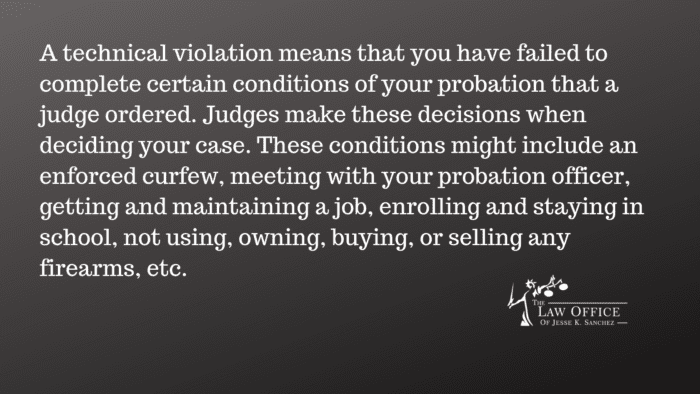
In Indiana, ANY violation of probation is serious in nature, however and too often technical probation violations are taken lightly. Again, this is definitely not the case. Items that are considered as technical violations of probation are items like:
All of these items would be fairly easy to prove felony violations of probation. The consequences of the technical violation of probation can be devastating to say the least. It’ s important that if you are facing felony probation violation consequences, you contact a probation violation attorney as soon as possible.
The act of violating probation is not in and of itself a felony or a misdemeanor. However, if you are convicted of a felony or a misdemeanor, then more than likely the probation officer will file a probation violation, and the judge takes into account a preponderance of the evidence, which means that the judge considers if it was more likely than not that you violated the terms of your probation. You should be especially concerned with a probation violation for a felony offense. Why? A felony offense probation usually has a penalty of prison time
If you have a felony probation violation, you will be required to attend a court hearing to determine if you, violated the conditions of your felony probation and must deal with the end result of your violation. Some of the consequences for a felony probation violation include the following:
Remember, when the court places an offender on felony probation, they are offering that person a chance to live at home, with the chance to work, go to school while still residing in their community, even with a criminal conviction. It’s important to remember the gift of probation when the court grants probation for a felony or for a misdemeanor offense.
Felony Probation is an opportunity to remain relatively free while following a set of requirements. Can you violate probation and not go to jail? The answer is, it depends. Often, depending how egregious are your first probation violation circumstances can depend on how lenient or harsh the repercussions of the first probation violation will be. The wise decision would be not to violate at all. However, we all make mistakes. If you do happen to commit a probation violation for your felony offense, consequences can be tough or very tough. Get in front of your probation violation today. Call an Indianapolis probation violation attorney at (317) 721-9858.
What happens if I refuse to take a breathalyzer test in Indiana? Well, all states, Indiana included, have “implied consent laws” that come into effect when you are tested for BAC and your BAC is either over legal limit of .08 percent or if you refuse to take a chemical test for BAC when requested by an officer. When an Indiana breathalyzer test is administered at a roadside location, or any other location for that matter, Indiana drivers have an implied consent to taking a certified breathalyzer test. While chemical testing, which is completed via blood or urinalysis is administered at a medical or detention facility.
Under the Indiana implied consent law, there is a good chance that you will be arrested for “per se intoxication“. Per se intoxication means that when you refuse chemical testing or refuse to take a field sobriety test, you can be prepared for the officer to exercise their ability to place you under arrest for suspicion of DUI, but only if the officer has probable cause that you have been driving under the influence.
Under the Indiana implied consent law, there is a good chance that you may be arrested for “per se intoxication“. Per se intoxication means that when you refuse chemical testing or refuse to take a field sobriety test, you can be prepared for the officer to exercise their ability to place you under arrest for suspicion of DUI, but only if the officer has probable cause that you have been driving under the influence.
Tackling a DUI case can be challenging. While there are those that decide to fight a DUI without a lawyer, but for those who don’t, here are 5 of the most common questions to ask an Indianapolis DUI lawyer before hiring. If you’ve been charged with the suspicion of a DUI or a suspicion of an OWI in Indiana, then you need to call attorney Jesse K. Sanchez at (317) 721-9858 or email at info@jksanchezlaw.com for a consultation today. So, here are the best questions to ask your DUI lawyer.
One of the first questions to ask your DUI lawyer are pertaining to what is a DUI or what is an OWI in Indiana? While there is a difference between an OWI vs. a DUI, we’re going to discuss a DUI. DUI is an acronym for driving under the influence. A person is guilty of the offense if that person is driving and in actual physical control of the vehicle within the state and the person is under the influence of alcoholic beverages or any chemical substances set forth under the applicable statutes when affected to the extent that his or her normal faculties are impaired or when the person has a blood alcohol level of .08% or higher.
The term, “in actual control of the vehicle” means that the individual has or had the capability and power to dominate, direct or regulate the vehicle, regardless of whether or not he or she was exercising that capability or power at the time of the alleged offense. This means sitting behind the wheel with the keys in the ignition may meet this qualification.
In any criminal case it is unconstitutional to hold presumption of guilt against the defendant. However, the fact that the defendant had .08% or more by weight of alcohol in his or her blood is “prima facie” evidence that the defendant was under the influence. Studies completed by the National Highway Traffic Safety Administration have believed that you can become an unsafe driver at BAC levels of .08% or higher. .08% is a far cry lower than the initial BAC accepted level of .15% when the legal limit to drive while being intoxicated was first adopted in 1938.
It is widely accepted that the BAC for women is accumulated at a far increased rate than the BAC for men. As an example, a man aged 25 with the average weight of 170 lbs will achieve a BAC of .082% with 5 drinks in a 4 hour period, while a 25 year old woman with an average weight of 130 lbs will achieve a BAC of .088% with 3 drinks in a 2 hour period of time.
Yes, it is a crime to drive with an unlawful blood-alcohol level of .08% or above. If you refuse to take a breath, blood or urine test if requested to submit to one by a law enforcement officer, in most states you could potentially risk a license suspension. By accepting the privileges extended by the laws of the state of Indiana you have given your consent to submit to an approved chemical or physical test of your breath, or to a urine test for the purpose of detecting drugs. However, you may refuse to take such tests unless you are involved in an accident involving serious bodily injury or death to another human being. If you refuse to submit to a breathalyzer in Indiana, which is an implied consent state, this will ultimately result in an automatic suspension of your license.
Breathalyzer laws are different in every state, and Indiana is no exception. If you’re arrested for a DUI in Indiana, with the implied consent law, and if the officer takes away your license, your driving privileges will be suspended for 90 days for the first refusal of a breathalyzer test, or for a year if this is the second refusal to take a breathalyzer test.
While the law provides safeguards before an individual can be sentenced you must remember, driving is a privilege, not a right. Because of this, the state may withdraw that privilege if it has lawful grounds to do so. With a first conviction, a jail sentence is generally not mandatory if you’re convicted of a DUI, however this result is not guaranteed. For a second conviction within 5 years of a prior conviction, a minimum imprisonment term of five days is required. For a third within five years, it is considered a felony and the term is between one and five years.
If you’ve been charged with a suspicion of DUI/OWI, it’s best to speak with a lawyer that handles DUI cases. Give The Law Office of Jesse K. Sanchez a call today at (317) 721-9858 for help today. It’s time to find the best DUI/OWI lawyer for your case. We are here for you.